What does it take to lead an organisation that lasts — one that stands firm in faith yet adapts to change? At the India Management Summit, this question came alive through three powerful keynote addresses. Together, they offered a vision of leadership that is both deeply spiritual and practical, rooted in personal transformation, system-level stewardship, and a convictional call to redemptive leadership.
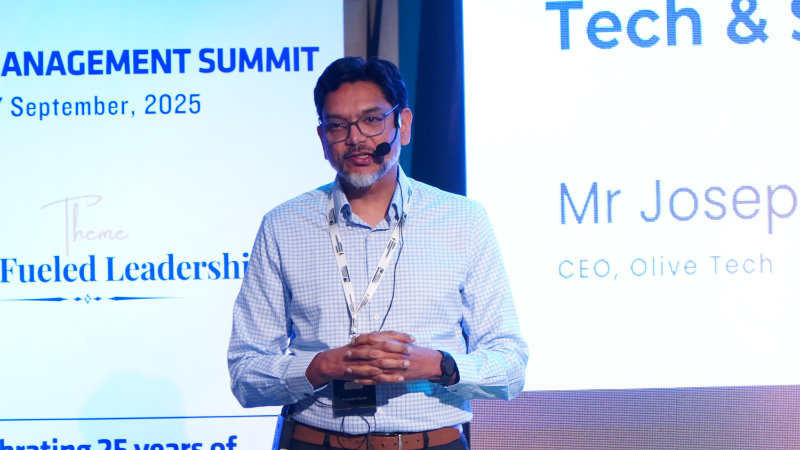
Mr. Joseph Vijayam, CEO of Olive Technology, spoke of resilience rooted in faith and stewardship shaped by technology. In his keynote on Future-Ready Institutions – Faith, Technology & Stewardship, he highlighted the interplay between faith, technology, and stewardship in shaping institutions that can withstand and thrive amidst change. He identified three major challenges that organisations face today — adapting to change, navigating people and culture, and managing external factors. Drawing from Nehemiah 4, he emphasised resilience and collaboration as essential qualities for leaders who wish to overcome these challenges and build strong, God-honouring organisations.
He explained that faith empowers us, serving as the foundation for resilience and purpose; technology equips us with tools that enhance capabilities and extend reach; and stewardship sustains flourishing, ensuring long-term growth and positive impact. On a personal level, individuals are called to cultivate healthy habits and personal growth. At the organisational level, he urged leaders to prioritise evangelism, discipleship, and operational efficiency, while at the societal level, he reminded institutions of their role in uplifting communities and serving the needy. Through it all, Mr. Vijayam pointed to Nehemiah’s example of faith-driven perseverance — a leader who faced opposition but built through unity and trust in God’s purpose.
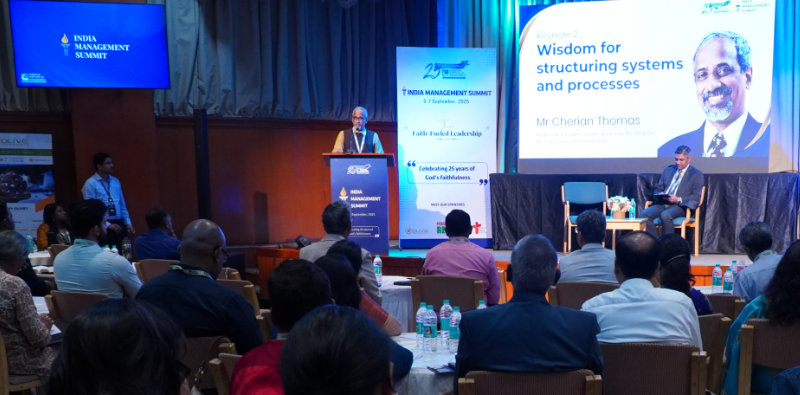
Echoing this call for resilience, Mr. Cherian Thomas reminded leaders that transformation begins within. In his keynote on Wisdom for Structuring Systems and Processes, he unpacked the spiritual depth of structuring and restructuring organisations, emphasising that Christ-like leadership is essential for true transformation. The right processes for building capacity, he explained, are not merely about efficiency and effectiveness but are a deeply spiritual exercise rooted in one’s vocational calling. “Transforming people starts with being transformed yourself,” he noted, underscoring the heart of his message.
Mr. Thomas went on to highlight that Christ-like leadership is not automatic — it demands sustained effort, inspiring leadership, and a willingness to lead with fairness and compassion, even in times of restructuring or downsizing. He described how such leaders build capacity for transformation rather than empires, structuring with grace, humility, and accountability to God and their communities. Christ-like leaders, he added, “walk the talk,” serve with integrity and excellence, and gracefully step aside when their purpose is fulfilled. He concluded by urging Christian professionals to structure and restructure with an unwavering focus on vision and mission, and core values, allowing their systems to serve people, not the other way around.
While Mr. Vijayam outlined what future-readiness looks like, and Mr. Thomas illuminated the spiritual posture required to sustain it, Dr. Ebe Sundaraj added another yet, an urgent layer — the call to lead with conviction. In his keynote address, Faithful Leadership in a Fractured World, Dr. Ebe called leaders to rebuild institutions with integrity, promote transparency and accountability, and practise redemptive management that prioritises relationships over winning. Beginning with Nehemiah 2:28, he reminded participants that leaders are called to build the Kingdom of God on earth.
He emphasised the need for structural reform in organisations, noting that “Ambedkar, the liberator of the Dalit slaves, had Moses, the liberator of the Hebrew slaves, as his inspiration and the Mosaic Constitution as his model (not the Hammurabi code nor the Manu Smruti) in drafting our National Constitution, incorporating a surpassing level of social justice, surpassing several European nations of that time.” He explained how CIM helps numerous organisations to review and amend their outdated Constitutions to meet their current needs.
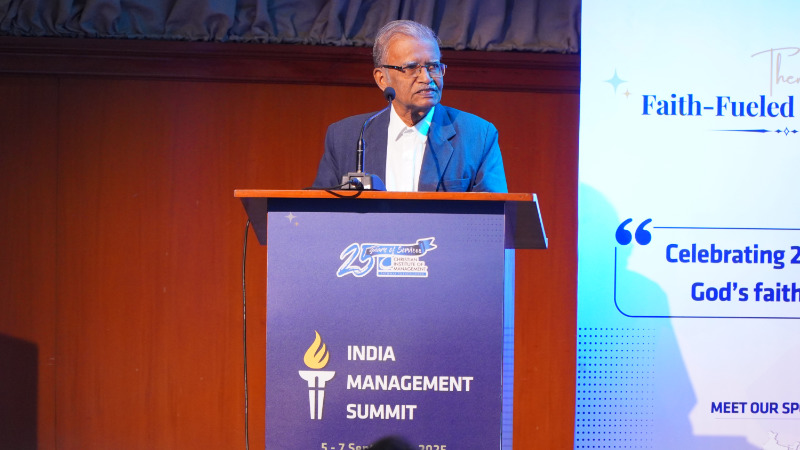
Highlighting Matthew 5:14–16, Dr. Ebe discussed the importance of transparency and accountability in Christian organisations. Publishing Audited Financial Reports and family assets in magazines was a practice carried out a hundred years ago. “Accountability is an offensive word today in a world of growing narcissism. Is God accountable to anyone? If he is not, then why should I?” the autonomous man asks. “Yes, God is mutually accountable within the Three Persons. The very first chapter of the Bible reveals this divine plurality in decision-making.”
Dr. Ebe drew a comparison between corporate and Christian management. The goal of Corporate Management is to generate maximum wealth for shareholders, whereas Christian Management aims to generate maximum health through our co-governance of the Kingdom — for spreading righteousness on the earth, which is the foundation of God’s throne. Wealth generation can be one of the means. Corporate management is motivated by ownership. Christian Management is encouraged by stewardship, as Sons of God for their Father’s Kingdom. Adult sons do not work for wages or reward from their father.
He continued, “Corporate management follows the Natural Evolutionary principle of ‘Survival of the Smartest.’ Christian Management includes the Survival of the Weakest, all the while recognising the smartest.” In some Companies, the ratio between their lowest-paid and the highest-paid is as high as 1:500. “The smartest must be paid very well for their high contribution, but not at the cost of depriving the weakest.” The Minimum Wage Act is a fading dream in India. “60 rich Indians own what 700 million Indians own together. Christian Management must set the model for the secular world and the State.”
“When all formulas in conflict management fail, feet washing succeeds. Secular management promotes winning, but that’s not enough. God promotes relationships.” With this, Dr. Ebe pointed to grace as the foundation of leadership — empowering leaders to persevere.
CIM, in the last 25 years, has trained about 40,000 leaders of organisations in management through its seminars conducted in 60 cities across India. 3,850 leaders were trained through Management Study Courses, from Module level to master’s level. Currently, 27 leaders are pursuing doctoral-level research in Christian Management. CIM has built up the Management Capacity level of over 500 major organisations and non-profits.
Dr. Ebe concluded with India’s responsibility. With digital media tools, we have crossed geographic boundaries. A good part of the management training can be done from India online to the nations in the Afro-Asian spectrum. On-site training can be built up for training the locals with a few high-end Indian management professionals. India, with its experience and expertise in Christian management and capacity building, has a responsibility to share with the world through digital and on-ground training, modelling a new standard of leadership rooted in grace and faith.
Dr. Ebe Sundaraj’s message set the tone for the IMS, challenging leaders to rise above the conventional model and embrace a redemptive, Kingdom-centred leadership rooted in grace, accountability and transparency.
In the end, all three keynote addresses converge on a timeless truth: Christian leadership is as much about strategy and systems as it is about surrender and stewardship. To lead effectively in a changing world, the Church and its institutions must be spiritually rooted, structurally sound, and convictionally clear — guided by faith, strengthened by wisdom, and committed to the stewardship of God’s plans and purposes.